Friday, November 22, 2013

Unit 2 - Day 1: Alsace - France


The Intensive Sommelier Training at the International Culinary Center in Campbell California consists of 8 units. Each unit covers a different portion of the wine world or other alcoholic beverages and wine management. At the end of each unit the students take an exam. At the end of the course students will take a final written exam, a blind tasting of 2 wines and be tested on service. They will also undergo the Certified Sommelier examination and upon completion they will be a Level 2 Certified Sommelier by the Court of Master Sommeliers.


In Unit 1 we had eight 4-hour lessons in which we covered the basics of viticulture, viniculture, still and sparkling wine service, decanting service and tasted numerous wines while learning the wine grid. We then had a summary overview of the entire world of wine. At the end of Unit 1 we had an exam which consisted of 27 questions and a blind tasting of 2 wines, one red and one white.


In Unit 2 we study France for 10 lessons, 4 hours per lesson. It is an enormous amount of information and we are tasting a large amount of wine, it is like wine tasting from a fire hose. As we go through the course I’ll share my notes about the regions and the wines we are sampling.


The Facts on Alsace


Alsace is located in northeastern France along the German border. Culturally it is a blend of German and France as the region has changed hands several times after the Franco-Prussian War to Germany (1871–1918), after World War I to France (1919–1940), during World War II back to Germany (1940–1944) and afterwards back to France (1945 - Present).


Alsace is the only region within France that does not label wines according to the region. Rather, Alsatian winemakers label their wines like German winemakers, by the grape varietal.


The majority (90%) of Alsatian wine production is dedicated to dry, white wine production. But they also produce small amounts of red wine, sparkling wine and late harvest or botrytised dessert wines.


There are 8 grape varieties legally allowed to be grown including Auxerrois, Chasselas, Gewürztraminer, Muscat, Pinot Gris, Pinot Noir (the only red grape), Riesling and Sylvaner. But the top white wines in Alsace are Riesling, Gewürztraminer and Pinot Gris. To have one of these grapes listed on the bottle the wine must contain 100% of that grape. If an Alsatian wine is labeled “Edelzwicker” this means “noble wine” and it indicates a blend of the allowed white wine grapes.


Alsace has 50 grand cru vineyards designated throughout the region. In order to have the designation they must be grown in one of these vineyards and they can only be made from Riesling, Gewürztraminer, Pinot Gris or Muscat. Less than 5% of the wines produced in Alsace receive this designation.


Alsace has three different Appellations d'Origine Contrôlées (AOCs):


(1)  Alsace AOC: for white, rosé and red wines

(2) Alsace Grand Cru AOC: for white wines from certain classified vineyards

(3)  Crémant d'Alsace AOC: for sparkling wines.


They also produce two other interesting wines:


Vendange Tardive (“VT”), which means “late harvest” in French. It is a wine made from ultra ripe, late harvest grapes that have very high sugar content and fully developed flavors.


Sélection de Grains Nobles (SGN) which is French for “selection of noble berries” which is a sweet dessert wine made from fully ripened grapes infected with botrytis.


The Terroir of Alsace


There are 2 major factors that affect the climate of Alsace: the Vosges Mountains to the west and the Rhine river to the east. Alsace is one of the driest regions in France due to the “rain shadow” affect of the mountains. 


A rain shadow is a dry area on the lee side of a mountainous area (away from the wind). The mountains block the passage of rain-producing weather systems and cast a “pencil” of dryness behind them.


Trimethyl-dihydronaphthalene


One of the aromas you will read in my wine descriptions is the note of petrol which is sometimes described as kerosene. We didn’t discuss this much in class but I have always thought that this unique trait in some older Rieslings, or those from very sunny regions, to be interesting. So, what causes this aroma in some Rieslings? It is caused by a terpene called Trimethyl-dihydronaphthalene (TDN).[1] I’m not a chemist so I won’t go on to talk about what causes this trait.[2] The issue I am more interested in is whether this trait should be considered a flaw. I recently talked to a chemist about TDN and when I told him it made the wine smell like petrol he said “I’m not surprised, because naphthalene is what goes into making mothballs.” Of course many things we eat are naturally composed of chemicals that may sound odd so we can’t immediately label it a wine flaw. Some people don’t like Brettanomyces (“Bret”), a non-spore forming genus of yeast in the family Saccharomycetaceae, in their wine as gives wine a very distinct aroma of “poop” or “barnyard” and yet it is commonly found in minute amounts in many high-quality Burgundies. In small amounts some people think it adds an element of complexity. I would argue that TDN in small amounts likewise gives some Rieslings an interesting layer of complexity than can be enjoyable so long as it doesn’t dominate the profile of the wine.


The Wines


We tasted the following nine wines in class from various producers. I enjoyed all of the wines and for the most part it was my first time experiencing Alsatian wines so even if some may have seemed a bit odd, they were a great learning experience.


1. 2011 Domaine Ostertag, Pinot Noir, Rouge E


The is a clear day-bright ruby red wine at the core of medium intensity with a tinge of pink at the rim. On the nose it is clean with moderate intense aroma of fresh cherries and cranberries, under ripe strawberries, dried roses and a hint of funky earth. On the palate it is dry with medium+ acidity, medium- tannins and medium bodied with flavors of tart red fruits and a medium length finish. It is a quality wine that lacks the finesse of a fine Burgundy or the deliciousness of a New World Pinot of comparable price. This wine sells for about $25 retail.


2. 2011 Meyer-Fonné, Gentil


This wine is a blend of Muscat, Pinot Blanc, Riesling and Gewurztraminer. It is clear star-bright straw-yellow wine of medium concentration and medium viscosity. On the nose it displays aromas of orange blossoms, ripe oranges, canned fruit salad, honey dew melon, with Botrytised notes of honey and a hint of marshmallows from a kid’s breakfast cereal. On the palate it is dry but fruit forward with medium+ acidity, medium alcohol, and moderate complexity with a long finish of canned pears. This wine sells for about $14 retail.


3. 2010 Kuentz-Bas, Pinot Blanc


This is a clear white wine, straw-gold and star-bright of moderate intensity. On the nose it is clean with subtle aromas of pears, melon, persimmons, subtle notes of tarragon, a hint of bready yeast but a prominent character of white chalk. On the palate it is a dry moderate bodied wine with medium+ acidity and a medium length finish of lemon rind and chalk. The minerality of this wine is the central player. This wine sells for about $16 retail.


4. 2011 Domaine Osterag, Gewürztraminer


This is a clear white wine with minor fluctuation, star-bright, golden-yellow at the core with moderate viscosity. On the nose this wine is clean with moderate+ intense aromas of canned pears, lemon-lime, honey-suckle, candied ginger, honey-crisp apples and lychee. On the palate it is clean, off-dry, with medium+ acidity, medium bodied with a viscous texture and a medium+ length finish with lingering notes of canned-pear juice. I have experienced numerous Gewürztraminer from California and none of them were this complex. This wine sells for about $27 retail.


5. 2010 Albert Boxler, Pinot Gris


This is a clear white wine, star-bright and golden-yellow with moderate viscosity. On the nose it is clean and yet with subtle notes of mustiness and moderate aromas of bruised and over-ripe apples, canned pears, and orange blossoms with yeasty notes of graham crackers, honey and oranges. On the palate it is off-dry, medium bodied with medium+ acidity and a medium+ length finish. This is unmistakably an Old World Pinot Gris. I have tasted numerous Pinot Gris in California and Oregon (it is their #1 white wine) and none of them are this complex as most of them seem to be fairly light-weight summer-drinking wines. But if that is what you are accustomed to drinking, this one may take some time to recognize as a Pinot Gris. This wine sells for about $28 retail.


6. 2010 Meyer-Fonné, Kaefferkpf, Pinot Gris
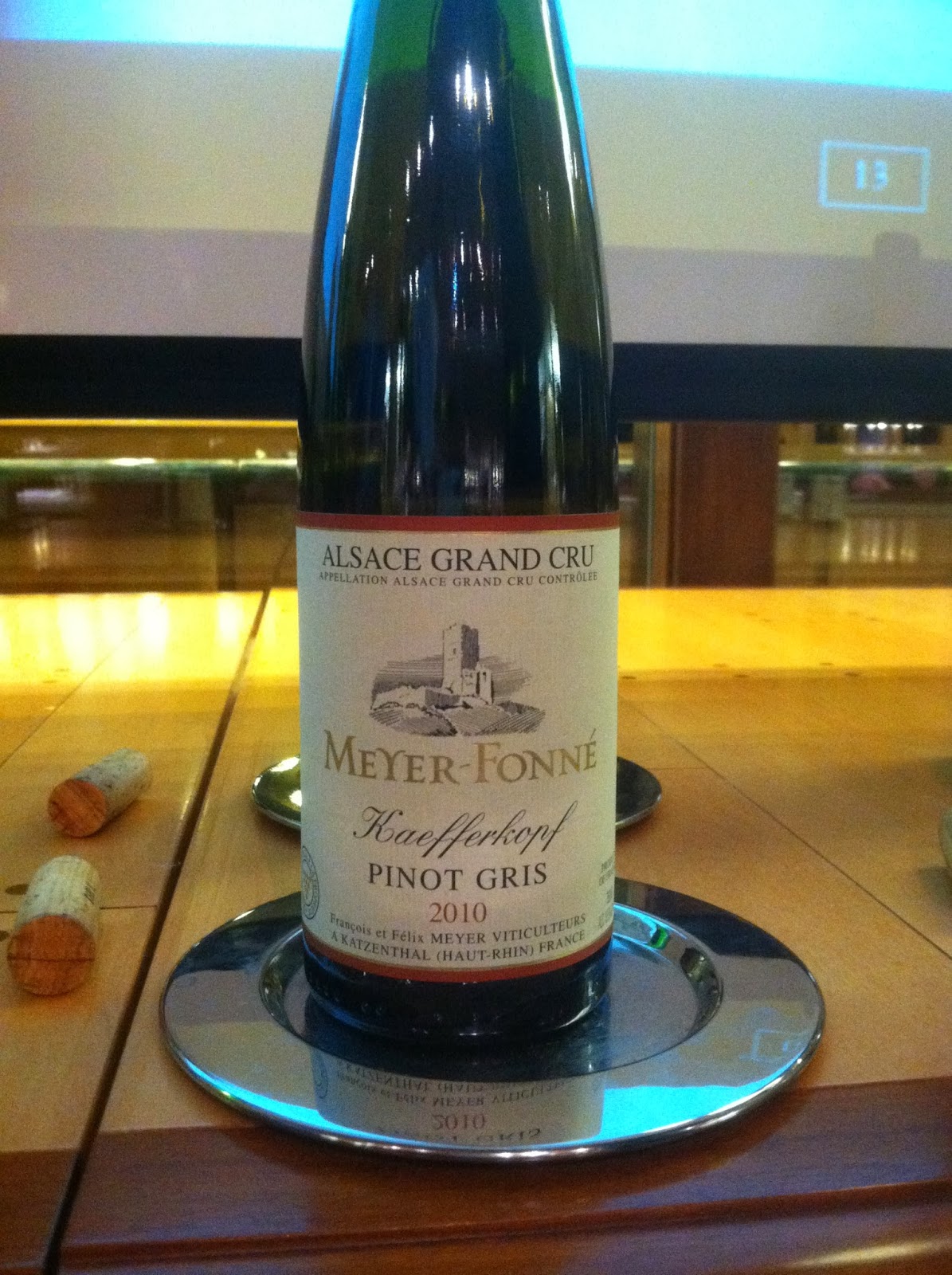


This is a white wine that is clear star-bright with low intensity golden colors at the core with minimal rim variation. On the nose it displays medium intense aromas of honey crisp apples, canned pear syrup and honey. On the palate it is clean and sweet with medium+ acidity, medium body and a medium length finish. This wine sells for about $30 retail.


7. 2011 Meyer-Fonné, Pfoeller, Riesling


This is a clear white wine, with low intensity golden hues with medium viscosity. On the nose it has aromas of golden delicious apples, lemon-lime margarita mix, golden raisins, apricots and minor notes of petrol. On the palate it is dry with medium+ acidity, medium+ alcohol, medium body and notes of dried apricots and dried peaches on a medium+ long finish. This wine sells for about $30 retail.


8. 2010 Domaine Weinbach, Riesling, Cuvée Theo


This is a clear golden wine that is star-bright of moderate+ intensity and viscosity. On the nose it is clean with moderate aromas of melon rind, bruised apples, graham crackers with underlying notes of white pepper and petrol with a metallic minerality. On the palate it is dry with medium+ acidity, medium+ alcohol and a lingering medium+ finish of moderate complexity. This wine sells for about $35 retail.


9. 2009 René Muré, Clos Saint Landelin, Riesling


This is a clear white wine that is star-bright and golden, youthful with moderate intensity. On the palate it is clean with aromas of bruised apples, lemon-lime, canned pears, graham crackers, and quince with minor notes of petrol. On the palate it is clean and dry with medium+ acidity, medium bodied with a medium+ length finish with additional notes of apricots, dried peaches and ginger. This wine sells for about $31 retail.


[1] Chemists actually label it: 1,1,6-trimethyl-1,2-dihydronaphthalene.


[2] For more information see: http://www.awri.com.au/wp-content/uploads/Sept-Oct-2012-AWRI-Report.pdf

Wednesday, November 20, 2013

2010 Pulenta La Flor Malbec – Mendoza, Argentina


Although Malbec is technically a Bordeaux varietal it is rarely, if ever, used in the region. Today in France its modern roots are found in Cahor where it is often blended with up to 30% Malbec and/or Tannat. But if you ask anyone today what country comes to mind when they think of this wine without hesitation they will say, “Argentina!”  

On Day 6 of the ICC’s Intensive Sommelier Training program we tasted 7 wines; the 5th wine was the 2010 Pulenta La Flor Malbec from Mendoza, Argentina.

The Terroir of Mendoza

One of the most important characteristics of Mendoza’s terroir is its high altitude in the Andean foothills. In this region winegrowing areas average between 3,000 and 5,000 feet above sea level. As altitude increases, the average temperature decreases, in general 1 degree Celsius (1.8 degrees Farenheit) for every 100 meter (328 feet) increase in elevation.

The result of the varying altitudes for vineyards in Mendoza is that there is a wide fluctuation in diurnal temperatures with bright sunny days and cool nights which enhances the gradual ripening of the fruit. The Mendoza also typically experiences mild weather during the harvest season which gives the grapes extended hang-time which enhances excellent phenolic ripeness. This degree of ripeness goes beyond a simple and measurable level of sugar in the grapes. It means that, among other things, the tannins taste fully mature which minimizes aromas and flavors of “greenness” or “herbaceousness.”


In addition to high altitudes, the vineyards in Mendoza are rooted in alluvial clay, sand and rock soils which are low in vegetation so they naturally control vine vigor and yield. The mountainous formation also provides thorough drainage which encourages the vines' roots to dig deep into the rocky soil rather than seek alternative water sources which would encourage constant growth and which would result in flabby wines.

In addition to its high-altitude and rocky soils, the Mendoza has a desert-like climate with an average rainfall of only 8 inches per year. Consequently the vineyards are dependent on irrigation from mountain spring water that flows from the melting snow caps high in the Andes. To make this possible an elaborate canal system, which dates back to the Pre-Columbian Incan Empire, channels the water to the vineyards below. The result is, although the Mendoza has an arid climate the extensive irrigation through the surrounding landscape sustains cultivation with Mediterranean characteristics.

Pulenta Estate Winery

The Pulenta family has been involved in the Argentine viticulture for three generations. In 2002 Eduardo and Hugo Pulenta founded the Pulenta Estate Winery. But the family winemaking tradition began 100 years earlier in 1902 when Eduardo and Hugo’s grandparents emigrated from Italy to Argentina. They then planted a vineyard on a 5 acre land with a small shed for a winery.

The Estate is located in Alto Agrelo, Luján de Cuyo, Mendoza, Argentina, one of the most prestigious winemaking areas of the province. What began as only 5 acres has been expanded to 333 acre vineyard that grows at 980 meters (3,215 feet) above sea level. The vines, which were brought from France and Italy and planted by Antonio Pulenta, flourish at the feet of the majestic Andes Range which provides fresh water for irrigating the Estate.[1]

The Wine

The 2010 Pulenta La Flor Malbec is 100% Malbec. It is opaque dark purple at the core to violet at the rim with medium+ viscosity with pink tears staining the glass when swirled. On the nose it has moderate intense aromas of blueberries, black cherries, violets, dark chocolate and vanilla with definite signs of new oak. On the palate it has medium tannins, moderate acidity but fairly high (medium+) alcohol that gives the wine a touch of sweetness on a medium length finish. It wasn’t one of the most impressive Malbecs I have ever tasted, but the La Flor is their entry-level tier which retails for only $16.99, so it is a fair quality wine for the price.


[1] http://www.pulentaestate.com/wine-la_flor.htm

Saturday, November 16, 2013

2011 Heinz Eifel Riesling Kabinett – Mosel, Germany


One of the most challenging wine producing regions to learn is Germany. German wine laws and labels are some of the most technical and (especially for Americans) the names of the indigenous grapes can seem strange and difficult to pronounce. Have you ever heard of Dunkelfelder, Heroldrebe, Schwarzriesling, Scheurebe, Weißer, Huxelrebe, or Zweigeltrebe wine grapes? Can you even pronounce any of these? Have you ever heard of, and can you pronounce, the Hessische Bergstraße wine region?

Although it only ranks 9th in terms of production, very high quality German wines, especially Riesling, can be some of the most food friendly and affordable. While Riesling can be found in New World Wine regions such as California, Washington and in Australia it is in Germany and Austria that ripeness becomes a key factor of quality as indicated the terms that are unique to their labels.

On Day 6 of the ICC’s Intensive Sommelier Training program we tasted 7 wines; the 4th wine was the 2011 Heinz Eifel Riesling Kabinett from Mosel, Germany.

It is ALL About Ripeness!


In Germany sunshine and heat are at a premium so ripeness of the grapes becomes a key factor for determining the quality and style of the wine. There are 5 styles, or levels, of sweetness:

Trocken: Dry
Halbtrocken: Half-dry
Feinherb: Off-dry
Lieblich: Semi-sweet
Süß or Edelsüß (Suss or Edelsüss): Sweet

There are also four general categories for German wine. The lower two are tafelwein (“table wine”) and landwein (“land wine”). The top two categories for quality wine are Qualitätswein and Prädikatswein. “Qualitätswein” is short for Qualitätswein bestimmter Anbaugebiete (QbA) which designates “quality wine from a specific region.” “Prädikatswein” is short for Qualitätswein mit Prädikat (QmP) which designates “superior quality wine.” Prädikat is then further designated according to a scale of ripeness for German grapes as follows:

Kabinett - Literally “cabinet”, meaning wine of reserve quality which can be either semi-sweet with crisp acidity or dry, if so it will stipulate “trochen” on the label.

Spätlese - Means “late harvest” as the grapes are picked at least 7 days after normal harvest. These wines are usually semi-sweet, and may be sweeter and fruitier than Kabinett and have heavier body but they are bot as sweet as “late harvest” designated wines in the USA.

Auslese – Means “select harvest” and the wines are made from very ripe, hand selected bunches, typically semi-sweet or sweet, sometimes with some noble rot character. Auslese is the Prädikat which covers the widest range of wine styles, and can be a dessert wine. But these may also made into a powerful (higher alcohol) dry wine labeled as Auslese trocken.

Beerenauslese – Means “select berry harvest” and it refers to rich sweet dessert wines from overripe grapes individually selected from bunches and often affected by noble rot.

Trockenbeerenauslese - Means “select dry berry harvest” and the “Trocken” refers not to the style of wine but rather to the status of the grapes which are overripe raisened grapes often affected by noble rot making extremely rich sweet wines.

Eiswein (ice wine) – Refers to Prädikat wines made from naturally frozen grapes, rather than grapes affected by noble rot, that are left on the vine and individually picked. The must is required to reach at least the same level of sugar content as a Beerenauslese.

There are 13 designated wine regions in Germany called Anbaugebiete which may appear on the label. These 13 large appellations are then divided into Bereich, a district, of which there are 39. These Bereiche are then further divided into a Großlage (Grosslage), which is a collective name for a number of single vineyards, and which number about 170. These may then be categorized as special vineyards (of which there are 2,600) referred to as Einzellagen (‘individual sites’). There are seven Deutscher Wein regions: Rhein-Mosel, Bayern, Neckar, Oberrhein, Albrechtsburg, Stargarder Land and Niederlausitz. These are then further divided into 19 landwein regions, which must be either trocken (“dry”) or halbtrocken (“off-dry”) in style.

Keep in mind that the Certified Sommelier must be able to pronounce all these words and have all of this information memorized. Yet, there is still much more that could be said about German wine regions, designations, varieties and winemaking. But I’ll save that for another review!

The Terroir of The Mosel


The Mosel wine region has a northerly continental climate that is marked by cool temperatures. The best producing vineyard sites are located along the Mosel River and its tributary where the heat from the sun can be maximized by reflecting up from the water. 
In order to obtain maximum sun exposure, the best sites have south and southwest facing slopes which provide direct exposure to sunlight that for ripening of the grapes. 

The Mosel River dominates the geography of the region which is divided into three main sections:

The Upper Mosel is the southernmost section located closest to the river’s origins along the French and Luxembourg border. The region includes the Saar and Ruwer river tributaries and is centered around the city of Trier.

The Middle Mosel or Mittelmosel is the main wine growing region and includes the villages of Bernkastel and Piesport. The Middle Mosel begins at the village of Zell and extends south to just north the village of Schweich. The slate-based soil here is said to have one of the most recognizable terroir with the wines, especially Riesling, displaying slatey mineral notes.

The Lower Mosel includes the region south of the city of Koblenz to the village of Alf near Zell. It is the most northern wine region of the Mosel and includes the area's confluence with the Rhine River.

The soil of the area is dominated by porous slate which has ideal drainage for the regions heavy rainfall and good heat retaining properties. Many of the best vineyards have no topsoil at all, just broken slate. During the summer months the weather is warm but rarely hot with July’s average temperatures around 64 °F (18 °C).

The Wine

The 2011 Heinz Eifel Riesling Kabinett is 100% Riesling. It is clear star-bright yellow-gold of medium concentration with minor green tinge, no rim variation and medium viscosity. On the nose this wine displays medium intense aromas of bruised apples, canned pears, golden raisins, peaches, apricots, and honey with noticeable signs of botrytis. On the palate it is off-dry, medium bodied with medium+ acidity and a medium length finish with lingering notes of mandarin oranges. I have experienced many Rieslings from California and Washington State and none of them are as complex as this wine. This is a great wine that retails for only $13 - $14.

Thursday, November 14, 2013

2012 Mohua Sauvignon Blanc – Marlborough, New Zealand


In a previous post I reviewed three Sauvignon Blancs that I tasted in a Study Group that were from distinctly different locations - California, New Zealand and Sancere. In that review I described the similarities and differences of their profiles that are typical of their terroir. But, I didn’t go into detail about the different appellations that make these Sauvignon Blancs so unique and their wines so recognizable.


On Day 6 of the ICC’s Intensive Sommelier Training program we tasted 7 wines; the third was a 2012 Mohua Sauvignon Blanc which was from Marlborough, New Zealand. This wine is very similar to the 2012 Kim Crawford Sauvignon Blanc from Marlborough, New Zealand that I tasted in the Study Group. But what is it that gives Sauvignon Blanc its unique profile and makes those from New Zealand distinct from those of California and Sancere?


It is Pyrazine That Makes The Wine Smell Green!


Sauvignon Blanc has a very distinctive grape fruit aroma that sets it apart from all other white wines. Even if the Sauvignon Blanc is from a warmer region that causes it to display more stone fruit (peach, nectarine, apricot) or tropical characteristics (mango, kiwi, passion fruit), the grapefruit is almost always in the wine. A second and very common attribute in Sauvignon Blanc is a green vegetal characteristic (often described as being like jalapeno, bell pepper, herbs, or grass) that is more prevalent if it is from a cooler climate. The bell pepper aroma and flavor can also be found in red wines such as Cabernet Sauvignon and Cab Franc, especially if they are from a cooler region or cooler vintage. So, what is it that gives these wines that distinctive green characteristic?


It is pyrazine!


Pyrazine is a natural component of many fruits and vegetables and there are three different types:


Isobutylmethoxpyrazine
Isopropylmethoxpyrazine
Sec-butylmethoxpyrazine

The first is more prevalent in fresh bell pepper; the second in green asparagus or peas, and the third in beets. Methoxypyrazines are found in grapes and contribute largely to the herbaceous and bell pepper characteristics. All pyrazines have very low sensory detection thresholds (one to 2 ng/L in white wines and 10 – 15 ng/L in red wines ). Consequently a single grape with pyrazines in 500,000 metric tons of grapes can change the smell of the entire batch and have a significant aromatic and flavor impact on a wine.


While pyrazine may be desirable in Sauvignon Blanc, in red wines it can undermine the black and red fruit characteristics of a wine if it is excessive. Merlot, Cabernet Sauvignon, and Cabernet Franc in cool vintages and regions can contain high enough amounts of pyrazine to make the wine seem as if the grapes were under ripe when harvested and consequently denote a lesser-quality wine.


To counteract this herbal quality in Sauvignon Blanc some wineries will add a small amount of Semillon and/or Muscadelle.  With red wines, greater hang time is allowed for the grapes or other red varieties are often blended in to counterbalance the green notes in the wine.


The Climate and Soils of Marlborough, New Zealand


Now we know that it is pyrazine that makes a wine smell green, why is New Zealand Sauvignon Blanc are so intensely green? The distinctiveness of Marlborough Sauvignon Blanc is due to its unique terroir. Marlborough is located on the east coast of the South Island with mountains to the west, and it is one of the country’s sunniest and driest areas.  In these sunny but relatively ‘cool’ climate conditions, the grapes experience a long slow ripening period.  The average daily temperature during summer is nearly 75 °F (24 °C) but clear cool nights keep acid levels high in the grapes. These cool temperatures with cool/warm diurnal (day/night) temperature variations are a key factor behind the ability of Marlborough grapes to retain both fresh, vibrant fruit and crisp, herbaceous characters.


In addition to having a cool maritime climate, viticulture in Marlborough has been developed primarily on sites with moderate-low fertility and noticeable stony, sandy loam topsoil overlying deep layers of free-draining shingle.  These shallow, fast draining, low fertility soils help to produce a lush, aromatic ripe wine because they reduce the vines vigor.  Where a more herbaceous style is desired, sites with greater water retentive soils and moderate fertility are chosen.[1]

The Wine


The 2012 Mohua Sauvignon Blanc is clear with low intensity watery straw-yellow with hints of green around the edges. On the nose it displays classic medium intense aromas of grapefruit, bell pepper, jalapeno, melon rind, granny-smith apple, lemon blossom and chives. On the palate it has medium+ acidity with medium body and a medium+ length finish. While this wine does display the hallmarks of a New Zealand Sauvignon Blanc it isn’t quite as intense and sharp as the 2012 Kim Crawford Sauvignon Blanc, so I preferred this wine. This wine sells for $12-15 retail.


[1] http://www.wine-marlborough.co.nz/