The Intensive Sommelier Training night
course at the International Culinary Center is 17
weeks long, four hours per night (6 to 10 PM), 3 nights per week (Monday to
Wednesday).
I
drive an hour in bumper-to-bumper traffic from my home in the east bay to my
place of employment in the west bay across the bridge. I then work 9 hours,
drive an hour to 90 minutes in bumper-to-bumper traffic to the south bay to
Campbell to the International Culinary Institute. After being in class for 4
hours I then drive an hour to get home at around 11:15 PM. I get to sleep
around midnight and then get up around 5 AM the next day to start the process
all over again. Ever since this class started I have been experiencing sleep
deprivation, but I knew I was in for that when I signed up for the class.
What
I had not anticipated was that I have now had a cold since September (or a
combination of a cold and severe allergies) which further drains me of energy
and I have to use medications just before class to clear my head so I can smell
the wine.
But worse
than all that, just before the class started my mother died (my father died 4
years ago) and I am the executor of the estate and trustee of the will so I
have had to manage all of her affairs. After planning and arranging my mother’s
burial and memorial service I have been spending 4-6 hours every Saturday
packing boxes in order to get the house I grew up in ready for sale. This has
been time consuming and emotionally draining, not to mention having to deal
with the wave of emotions of grief that bombard me.
So,
beyond the challenge of the massive amount of information I have to absorb, the
long hours of driving in bumper-to-bumper traffic, the loss of sleep and the
dealing with grief and managing my mother’s affairs the sommelier training has
become a test of endurance. I thought about delaying taking the sommelier training
until after I finished dealing with all this stuff, but I had already paid
$9,880 in cash and I decided that I needed something else to put my mind on.
Also, on Saturdays I have been getting together with some future sommeliers for
a study group. In addition to tasting some great wines and having fun, we’re
learning a lot and enjoying the camaraderie. That also has been a helpful
diversion from the mourning process.
In
Unit 2 of The Intensive Sommelier Training we have studying the wine regions of
France for 10 days. The reality is, we could spend the entire course studying
France and we would still be just skimming the surface. It is that important and complex. France is
the #1 producer of wine in the world and they provide 50% of the premium
quality wines in the world. On the sixth day we studied Rhône, Provence and Corsica.
Northern Rhône

The
most important white grape in the Northern Rhône
is Viognier and the top red is Syrah. In fact, Syrah is the only red grape in the north. In the north Viognier is
often blended with two other white wine grapes, Marsanne and Roussanne. The
most important regions are the Côte-Rôtie and Hermitage.

Going from north to south the AOCs of the Northern Rhône are as follows:
Going from north to south the AOCs of the Northern Rhône are as follows:
Côte-Rôtie
means “roasted slope” and there are only 497 acres of vineyards which are
planted almost entirely on a steep hillside. While the only red grape is Syrah,
up to 20% of Viognier may be added. Within Côte-Rôtie are two well-known vineyards Côte Blonde and
Côte Brune. Côte Blonde has sand,
granite and limestone soils, while Côte Brune offers more clay and iron. Côte Blonde is
located slightly south of Côte Brine. These differences in terroir explain the power
and more masculine style of Côte Rôtie from the Côte Brune, versus the opulent, lush
qualities found in Côte
Blonde wines.
Condrieu
is dedicated to producing 100% Viognier. There
are now roughly 420 acres exclusively devoted to Condrieu production and its legendary
sub-region Chateau-Grillet is one of the smallest ACOs in France with only 10
acres. While dry Condrieu wines are the preferred style, sweet Condrieu wines are now labled Selection des Grains Nobles. Wines claiming the appellation title AOC
Condrieu Selection des Grains Nobles must be produced from grapes
harvested in multiple passes through the vineyard (known as tries
successives in French), beginning no earlier than 8 days after the
standard harvest. Cryoextraction (a controlled process that involves freezing
grapes to make artificial ice wine) and Chaptalisation (adding sugar) are
prohibited, although the rules do not prohibit passerillage sur souche – the
process of leaving grapes on the vines to dry them out and concentrate their
natural sugars and flavors.
Château-Grillet is
also dedicated to producing only white wines from 100% Viognier. The whole appellation, which is only 3.8 hectares (9.4 acres) in
size, is owned by a single winery, Château-Grillet. The appellation was
officially created in 1936.
The Saint-Joseph AOC covers the largest amount of land, but it is second in actual
size under vine to Crozes-Hermitage, an appellation with which it shares much
regarding style and prestige. While St.-Joseph is primarily a red wine region
based on the Syrah grape, there may be up to 10% of white (Roussanne or
Marsanne) grapes co-fermented in the blend.
Hermitage red wines are made of Syrah with small amounts (up
to 15%) of Marsanne and Roussanne blended in to add complexity. Hermitage white
wines are a blend Marsanne and Roussanne, are very aromatic and make up about
25% of production. Crozes-Hermitage is
notable for the large amount of cooperative wine. Cave de Tain, a large
cooperative, takes half of the grapes grown and another large producer,
Jaboulet, takes a big part of the other half, and also owns its own high
quality vineyard sites. The more notable vineyards in Crozes-Hermitage include
Les Chassis, Les Sept Chemins and Les Meysonniers
Crozes-Hermitage is the largest
appellation in the northern Rhone, and its wines are less highly regarded than
those from the nearby appellations of Côte-Rôtie or its near-namesake
Hermitage. Most of the wines produced here are red wines made from the Syrah
grape, sometimes blended with small quantities of white Roussanne or Marsanne
grapes. Some white wines are also made, based on Marsanne and/or Roussanne.
The Cornas AOC is south of Lyon just north of St. Peray and
Valence, south of St. Joseph on the western slopes of the Rhône River. It
is one of the smallest in the Rhone Valley. This region only produces red wine
and only from the Syrah grape. Unlike other northern Rhône red wines
blending with white wine is not permitted and no white wines are produced in
this region. The name Cornas is Celtic for “burnt earth” and the earliest known
written mention of wine being made in the region go back to 885 AD. Cornas
became an AOC in 1938 but growers did not begin to bottle their own wine until
1950. While the Southern Rhône has a Mediterranean climate, the Northern Rhône
has a Continental climate. While most of the northern Rhône appellations
are influenced by the cooling le mistral winds Cornas is
mostly shielded from the and consequently they are usually the first to harvest
their grapes. The vineyards are fairly small and are planted on steep slopes
facing east south-east 100 to 400 meters above sea level. In the northern end
of Cornas the soil consists of chalk, sand, and is rocky with reddish-brown
dirt.[1]
Sparkling Wines Of The Rhône Valley
Two small lesser
known appellations are St. Péray and St. Peray Mousseux
AOC. They are located in the southernmost
part of Northern Rhône. All Saint-Péray wine is white and they produce some still wines but they are more
known for their sparkling wines made
from Marsanne and Roussanne.
Crémant de die produces sparkling wines from the Muscat Blanc à
Petits Grains (75% minimum) and Clairette (25% maximum). It is vinified using
the traditional Champagne method of a first fermentation in the vat followed by
a second fermentation in the bottle. Originally it was produced using 100%
Clairette but now Aligote and Muscat are included.
Southern Rhône
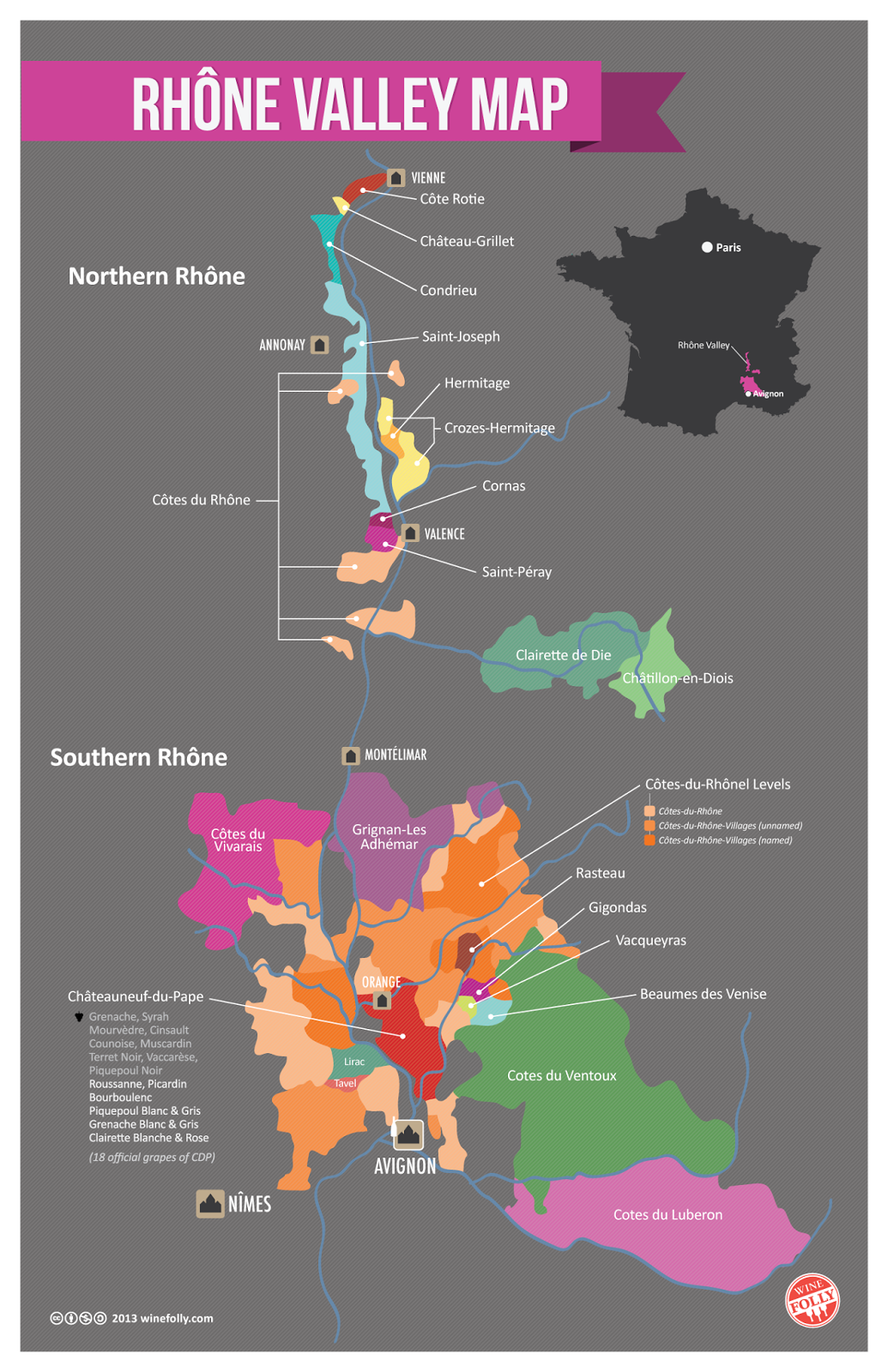
The
Southern Rhône is much larger
than the Northern Rhône and it is responsible for 90% of the Rhône Valley’s wine
production. It is also much warmer in the south due to its proximity to the
Mediterranean, consequently the ripeness levels can be very high.
The soils consist of
Alluvial clays in Gigondas to alluvial deposits in Châteauneuf-du-Pape. The most well-known regions in the south
are Côte-du-Rhône and Châteauneuf-du-Pape and high quality rosés
are produced in the Tavel AOC.
The most important red
grape in the south is Grenache followed by Syrah, but there are 8 red varietals
including Cinsault, Counoise, Mourvèdre, Muscadine, Terret Noir and Vaccarèse,
which is also referred to as Camarèse or Brun Argenté
(“silvery brown”).
There are also 6 white grapes including Bourboulenc, Clairette, Grenache Blanc
(a white mutation of Grenache), Picardin, Picpoul, and Roussanne. Note that
there is no Viognier.
The Côte-du-Rhône is the largest
appellation (nearly 100,000 acres) in the Rhône Valley and produces nearly half
of the wine in the region. It is primarily a red wine region but white wines (Grenache
Blanc) and rosés are produced as
well. While any of the important red grapes can be used most are a blend of made from Grenache noir, Syrah, Cinsault, Carignane, Counoise and
Mourvèdre grapes varieties. A maximum of 20% white varieties may be used in the
rosés. All reds grown south of Montélimar must contain a minimum of 40%
Grenache, and may contain up to 5% white grapes. A red from anywhere in the
appellation must contain a minimum of 15% Syrah and/or Mourvèdre. The whites
must contain a minimum blend of 80% Clairette, Grenache blanc, Marsanne,
Roussanne, Bourboulenc, and Viognier. Ugni blanc and Picpoul blanc may be used
as secondary varieties.
Côte-du-Rhône-villages is a sub-appellation located within Côte-du-Rhône
whose standards are stricter and the quality is usually higher. Red wines are produced from at least 50% of the Grenache grape
with 20% Syrah and/or Mourvèdre. A maximum of 20% of other authorized varieties
is permitted. The minimum required alcoholic strength is 12%.
The most well-known
AOC in the south is Châteauneuf-du-Pape which means “the
new house/castle of the Pope” and it
refers to a palace that was built in the city of Avignon that served as the
headquarters for the Catholic Church for 70 years in the 14th
century. In
1308, Pope Clement V, former Archbishop of Bordeaux, relocated the papacy to
the town of Avignon. Clement V and subsequent “Avignon Popes” were said to be
great lovers of Burgundy wines and did much to promote it during the
seventy-year duration of the Avignon Papacy. At the time, wine-growing around
the town of Avignon was anything but illustrious. While the Avignon Papacy did
much to advance the reputation of Burgundy wines, they were also promoting
viticulture of the surrounding area north of Avignon close to the banks of the
Rhône River. Prior to the Avignon Papacy, viticulture of that area had been
initiated and maintained by the Bishops of Avignon, largely for local
consumption. Clement V was succeeded by John XXII who drank Burgundy, as well
as the wines from the vineyards to the north, and did much to improve
viticultural practices. John XXII erected the famous castle that now stands as
a symbol for the region and the wines of this area came to be known as “Vin du
Pape”, which later became Châteauneuf-du-Pape.
Châteauneuf-du-Pape
mostly produces red wine and Grenache almost always makes up two-thirds of the
blend. While there are 13 varietals that can go into the blend, the most common
are Syrah and Mourvèdre. The grapes grow on soils covered in rounded,
smooth stones called galets
(pronounced “gah-lay”). The stones naturally cover most of the soils throughout
Châteauneuf-du-Pape
and provide two important functions: First, they are able to
reflect and absorb the heat which quickens the ripening of the grapes. They
also help to hold in moisture so that the soils are not dried out by the hot
Southern French sun. The region is one of the southernmost and the warmest so a
high level of ripeness is easily achieved and it has the highest minimum levels
of alcohol of any AOC in France.
Vacquèyras (pronounced VACK-a-rahs)
is along the banks of the River Ouvèze just east of Châteauneuf-du-Pape, in the
southernmost part of the Côtes du Rhône (although its address is Provence). It
wasn't until 1990 that Vacquèyras became an officially recognized appellation;
before that, its wines bore a “Côtes du Rhône” label. It is primarily a red
wine region (97%) with some white and rosé wines being produced. It is smaller
than Châteauneuf-du-Pape and Gigondas, but the wine is considered by some to be
“a poor man’s Châteauneuf-du-Pape.” The soils are sandy and stony and many
vineyards are located on hillsides, so the wines tend to be lower in alcohol
(14% to 14.5%) and higher in acidity than the wines from Châteauneuf-du-Pape. The backbone of the
wine is Grenache, and every blend must contain at least half, although
sometimes it accounts for as much as 90% of the mix. However some producers of
Vacquèyras use more Syrah than is used in Châteauneuf-du-Pape and Gigondas
which can make the style seem more like a Northern Rhône wine.
Gigondas (pronounced “zhee-gawn-dahss” or “jhee gohn dahs”) was one of the earliest
Rhône regions to receive official appellation status, in 1971. Like
Châteauneuf-du-Pape, it is home to sturdy red wines made with Grenache, Syrah
and Mourvèdre, which can be a bit bolder and more rustic than Vacquèyras with
higher alcohol.
Tavel is located on the eastern
bank of the Rhône River across from Châteauneuf-du-Pape AOC and just north of Avignon. It only produces rosé wines made mostly from the Grenache grapes
with Cinsault added that must have a minimum
alcohol content of 11% and maximum of 13.5%. Syrah and
Mourvèdre may also be added although they were not permitted until 1969. In
Tavel there are three types of soil, west of the village is dominated by
limestone and slate. Here, low-yielding vines grow giving deep and aromatic
wines. Another type is the flat sandy rocky fields, easy to cultivate and good
for ripening. The third is dominated by galets roules, the smooth round
stones also found in Châteauneuf-du-Pape. Rosé wine cannot legally be made in
France by blending red and white wines together, with the sole exception of
Champagne. Instead, rosé wine is made with red grapes only, pressed to remove
the juice from the skins after a short period of maceration (10-36 hours) in
order to extract some color. In Tavel, some of the must is kept with the skins
longer and then blended into the lighter must, which is what makes the wine
more powerful, more tannic and darker than other rosés. The potential alcohol
is high, with an upper limit of 13.5% for the appellation. They can be
cellared, but are usually consumed young.
Lirac is
an AOC that produces rosé wines that rival those of Tavel. The village of Lirac lies to the west of the Rhone in the
department of Gard, a little over 6 miles due west of Châteauneuf-du-Pape which
is on the opposite side of the river. The appellation also includes the
villages of Saint Laurent des Arbres, Saint Géniès de Comolas and Roquemaure
which forms a girdle around the appellation. The terroir in Lirac is somewhat
similar to Châteauneuf-du-Pape both in variety and hours of sun (2700). The
best terroir for red wine is perhaps on the windy plateau Vallongue,
shared with Tavel that is only 3.72 miles away. In the relatively newly planted
vineyards one finds plenty of galets roulés that retain heat. The area
is slightly cooler that the lowlands.
Rasteau produces wines primarily
from Grenache red, rosé, white wines as well as
Tawny and rancio Vin Doux Naturel.
Muscat de Beaumes-deVenise produces red, white and rosé Vin Doux Naturel wines only.
Provence is not a sub-region of the Rhône
Valley so
I would have preferred to discuss it in a separate review. But with limited
time and a schedule to maintain it was combined with our lectures on the Rhône Valley. Provence is located in the southeastern
corner of France along the Mediterranean coastline from the Rhône River in the west to the Italian border in
the east. Many of the best appellations are located around the city of Marseilles.
Similar to that of Languedoc-Roussillon, the warm climate of Provence is influenced
by the southern latitude and proximity to the Mediterranean Sea. Provencal winemaking is best known for and is
dominated by the production of dry rosé wines. Most wines
are made from a blend of Carignan, Cinsaut, Grenache, Syrah and Mourvèdre. There is also a small production of white wines from
Clairete, Grenache Blanc, Marsanne and Ugni Blanc. The largest AOC appellation
in Provence is Côtes de Provence. The most renowned
region in Provence is Bandol which
makes up the majority of the appellation’s production of which Mourvèdre must be
at least 50% of the red wine.

Corsica also is not a sub-region of
the Rhône Valley but is an island located a
few miles north of the Italian island Sardinia in the Mediterranean Sea. It was
one of the earliest regions of France to be planted with Grapes by the Greeks
and Romans and it was the birthplace of Napoleon Bonaparte, whose father was a
winemaker. The one indigenous grape that is widely grown is Scicarello but they
also grow other Italian varietals including the red grape Aleatico, the white
gape Vermentino, and Nielluccio – a clone of Sangiovese. Most of the wine
produced in Corsica is vin de pays
quality. The top AOC appellations of Corsica include Patrimonio and Ajaccio.
Learning Objectives of Unit 2 - Day 6: Rhône To Provence
At
the beginning of class lectures a list of learning objectives is provided to
the students. By the end of the class, the students should have a certain
degree of understanding from their own reading and the lectures and be able to
provide the answers to list of questions. Learning Objectives for Unit 2 - Day 6
along with the answers are as follows.
By
the end of class, students should be able to:
(1)
Name the grape of Condrieu and recommend a producer
Answer: Viognier - Le Domaine Georges Vernay
(2)
Discuss the other 2 white grapes of the Northern Rhône
Answer: Roussanne and Marsanne.
(3)
Differentiate between Northern and Southern Rhône reds
Answer: Syrah is the only red
grape in the north. Grenache dominates the south and is often blended with 13
other varietals particularly Syrah and Mourvèdre.
(4)
State the difference between Crozes-Hermitage and Hermitage.
Answer: The main difference is in the soil and location of the vineyards.
Hermitage has a granite soil while Crozes has more clay and sand. Hermitage
vineyards are located at the top of hill, gaining full exposure from the sun,
while Crozes-Hermitage vineyards are below.
(5)
Suggest two red wines from AOCs in the Southern Rhône and two
others from
the Northern Rhône.
Answer: In the south, the most
well-known red AOCs are Châteauneuf-du-Pape and Côte-du-Rhône. In the north Cornas is 100% Syrah
and Hermitage
is mostly Syrah.
(6)
State the regional AOC for the Rhône
Answer: Côtes du Rhône
AOC
(7)
Recommend a fortified wine from the Rhône.
Answer: Vin Doux Naturel
(8)
Recommend the best red wine of Provence to your guest.
Answer: Domaine Tempier, Bandol Cuvèe Classique.
(9) Suggest an AOC rosé from either the Rhône or Provence.
Answer: Tavel AOC, Château d'Aquéria
(10) Name the AOCs of the Northern Rhone for red wines
exclusively.
Answer: Cornas and Crozes-Hermitage
(11) Identify some
important AOCs in the Northern Rhone for both red and white wines.
Answer: St. Joseph, Hermitage,
Croze-Hermitage
(12) Describe the attributes of any wine we tasted today.
Answer: See below
The Wines

On
the sixth day of Unit 2 we tasted the following wines:
1. 2012 Commanderie de la
Bargemone, Coteaux d’Aix en Provence,
Provence

This
wine is clear low intensity peach color at the core, day-bright with medium
viscosity. The wine is clean and has subtle aromas of strawberries, bananas,
watermelon, and a hint of spice. On the palate it is dry with medium+ acidity, it
is light in body with a medium to long finish. On the palate it has additional
notes of tart cranberries, under ripe strawberries and tart plums and a chalky
minerality. This is a rosé wine made from 40% Grenache, 32% Cinsault, 15% Syrah, and 13%
Cabernet Sauvignon that sells at a fair price for about $13.
2. 2011 Chante-Perdix,
Condrieu

This
is a clear white wine, straw-gold in color, star-bright with low concentration
and low rim variation. On the nose it is clean with medium intense aromas of
white flowers, orange blossoms, ripe peaches, melon and minor green vegetation.
On the palate it has medium acidity, medium body and a medium length finish.
This wine is made from 100% Viognier. I am a big fan of this grape, especially
of those wines made in Santa Barbara and Paso Robles. They tend to be full
bodied and full of tropical fruits with pronounced floral aromas and cost
between $19 and $25. I was really disappointed with this wine and I hope it
isn’t a fair representative of Condrieu. I'll have to buy a few other producers and compare them in a future review. This wine sells for about $45!
3. 2011 Domaine Clape,
Saint-Peray

This
is a white wine, clear yellow-gold, star-bright with moderation concentration,
and medium viscosity. On the nose it is clean, youthful, with moderate intense
aromas of honey-crisp apples, oranges, apricots, honey and a hint of clove and
graham crackers. On the palate it has a zesty texture and slight hint of
bitterness as if biting into an orange peel. It has medium+ acidity, medium+
body, high alcohol and a medium+ length finish. This wine is 99% Marsanne and
1% Roussanne and was fermented in a vat. This was one of my favorite wines of
the evening and retails for about $38.
4. 2009 Domaine Mucyn,
Saint-Joseph Rouge

This
is a red wine, medium concentration of ruby at the core with minor pink
variation at the rim, day-bright with medium viscosity. On the nose it has
aromas of blackberries, plums, dried meat, black olives, tea leaves, and black
pepper. On the palate it has chewy medium tannins, medium+ acidity, medium body
and a medium length finish, it is well balanced and moderately complex. This
wine is 100% Syrah and it retails for about $30.
5. 2011 Domaine Faury,
Cote-Rotie

This
is a red wine, medium concentration of ruby at the core with minor pink
variation at the rim, day-bright with medium viscosity. On the nose it is clean
with pronounced gamey and earthy aromas but subtle fruit aromas. I picked up
beef-jerky, leather, bacon, decaying roses, blackberries and a hint of black
pepper. It has medium chewy medium tannins, medium+ acidity, medium body and a
medium length finish with notes of cigar box, plums and pomegranates. This wine
is 100% Syrah and it retails for about $52.
Notice
what these last two wines have in common that makes them distinct from the
following wine! Northern Rhone Syrahs are meaty and tend to have some kind of
decaying leaves/tobacco/tea leaves or forest floor character and the primary
fruit is blackberries.
6. 2011 Vignobles Yves
Cheron Domaine du Grand Montmirail Cuvee, Les
Deux Juliette, Gigondas

This
is a red wine that is clear to opaque with a dark purple core to violet with
minimal variation at the rim with medium+ viscosity that stains the glass when
swirled. On the nose the wine is clean with moderate intense aromas of
blackberries, plums, cooked strawberries, violets and dried roses. On the
palate it is dry with chalky medium+ tannins, medium+ to full bodied, medium+
alcohol and yet silky on entry and across the mid-palate. It has a medium
length finish with additional notes of dried cranberries. This wine is a blend of 80% Grenache, 15% Syrah and 5% Mourvèdre and it retails for about $20.
7. 2010 Mas de Boislazon, Châteauneuf-du-Pape

This
is a red wine, opaque purple at the core to violet at the rim with medium+
viscosity and tears that stain the glass. On the nose it is clean with moderate
intense aromas of dried cranberries, black cherries, cigar box, potting soil,
dried tealeaves and a hint of dried green herbs. On the palate it is dry with
chalky medium+ tannins, medium+ acidity, full bodied with medium+ alcohol,
moderately complex with a medium length finish. This wine is a blend of 70% Grenache, 15% Syrah and 15% Mourvèdre from
50-year-old vines aged in concrete tanks as well as old wood foudres. An extremely well balanced wine. It retails for about $50.
Notice
the similarities between the Gigondas and the Châteauneuf-du-Pape and yet the huge price
difference. I’d rather have two of the Gigondas and keep the $10 difference. The
Gigondas is not as complex and
is softer on the mid-palate but the Châteauneuf-du-Pape didn’t impress me
enough that I’d want to spend the extra $30.
8. 2010 Domaine de Durban,
Muscat de Beaumes de Venise, Vin Doux Naturel

This
is a white wine, clear, straw with minimal rim variation and high viscosity. On
the nose it is powerful and has pronounced floral aromas of orange blossoms, honeysuckle,
lavender and roses followed by fresh oranges, apricots, dried peaches, D'Anjou pear, and honey with subtle yeasty notes. On the
palate it is SWEET with medium+ acidity, medium+ body, high alcohol and a
medium+ length finish with lingering yeasty notes. This wine is 100% Muscat à Petits Grains Blanc that is dried on mats to
intensify sugar and flavor, fermented at 15°C, after mutage (neutral spirit
7-10% is added to stop fermentation) it has 110 grams per litre of residual
sugar and 15% alcohol. This wine is extremely sweet and I could even though I was
spitting the wine out I could feel the alcohol being absorbed through the
lining in my mouth. It retails for about $16 for a 375 ml bottle.
9. NV Bottex, Bugey-Cerdon, “La Cueille”

This
wine is clear, star-bright, magenta in color medium concentration and no rim
variation with obvious gas bubbles. On the nose it is clean with aromas of
fresh cherries, golden apples, Asian pear, under ripe strawberries, rhubarb, watermelon
with a hint of yeast. On the palate it is light and the flavors float off the
palate as the bubbles dissolve with a pleasing refreshing sensation. It is
off-dry with medium to medium+ acidity, medium- alcohol (8%) and a medium+ length finish. It is made from 90% Gamay and 10% Poulsard (an indigenous grape of the
region). It
retails for about $19 and would probably best served as an aperitif or perhaps
on the back porch on a hot summer day.
[1] On
October 14th I posted a review of a vertical tasting of Cornas which
you can read at: http://worldofwinetastingadventures.blogspot.com/2013/10/a-vertical-tasting-of-cornas-northern.html


