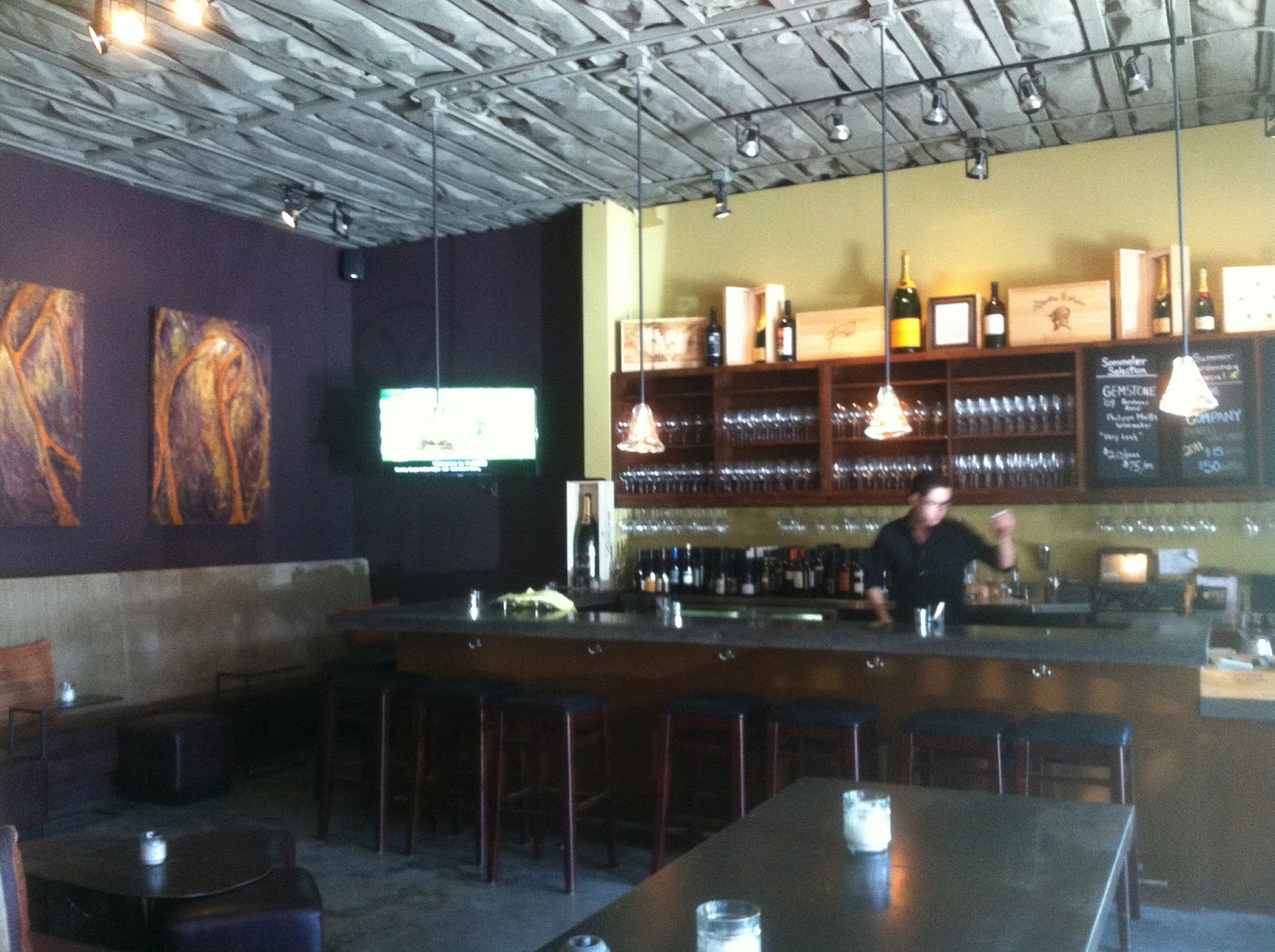
Showing posts with label The Vine at Bridges. Show all posts

Sunday, October 6, 2013

2011 Jose Pariente Verdejo – Rueda Region D.O., Castilla y Leon, Spain


I don’t have a large catalog of Verdejo in my brain, as there is very little of this grape grown in California. The ones I have found in my travels are either grown in the Sierra Foothills or in Lodi, warm and dry climates that are fairly similar to Spain’s Rueda region. Most of them tend to be very aromatic and have a slightly heavier body with more tropical notes and they can seem almost Viognier-like.


The Verdejo Grape


The Verdejo grape variety grows in small clusters of tiny grapes that have a thick golden skin which provides a defense against harsh dry climates. It has long been grown in the Rueda region of Spain but the grape originated in North Africa. In the 11th Century it was spread to Rueda, possibly by Mozarabs - Iberian Christians who lived under Arab Islamic rule in Al-Andalu. Verdejo was generally used to make a strongly oxidized, Sherry-like wine.


In the 1970s the winemaking company Marqués de Riscal began to develop a fresher style of white wine based on Verdejo with the help of French oenologist Émile Peynaud, who author of one of the best books on wine The Taste of Wine: The Art and Science of Wine Appreciation.  


In 1980 white wines from the Rueda region were recognized by a Denominación de Origen (DO). Wines labeled Rueda must contain at least 50% Verdejo; the remainder is typically Sauvignon Blanc or Macabeo. Wines designated “Rueda Verdejo” must contain at least 85% Verdejo but are frequently 100% Verdejo


The Rueda Region


Spain’s Rueda region is an elevated, dry land that sits on the Castillian tablelands northwest of the Spanish capital of Madrid. There is only one Denominación de Origen in the region of Rueda, which is “Rueda D.O.” The Denominación de Origen Rueda was approved by the Ministry of Agriculture on January 12, 1980. It was the first Denominación de Origen to be approved in the Region of Castilla y León, after years of hard work in order to earn acknowledgement and protection for its most well-known grape variety - Verdejo.


The region consists of 74 towns and villages, 53 of which are located south of the province of Valladolid, 17 to the west of Segovia and 4 north of Ávila. The different grape varieties grown here are irregularly scattered over the several municipal districts comprising Rueda Appellation of Origin. However, it is the area found within the boundaries of La Seca, Rueda and Serrada where vineyards are in a higher proportion and greater intensity.[1]


The Wine


The 2011 José Pariente Verdejo is made from 100% Verdejo from the Pariente family’s 30-year-old vineyard.[2] This wine is clear, straw-yellow and on the nose I picked up slightly under ripe bananas, peaches, white flowers and apricots. After much swirling (it was served rather cold) I picked up additional aromas of honeycomb and melon. On the palate this wine has high acidity, it is medium bodied and has a prolonged finish with lingering notes of zesty dried apricots.


I don’t give out wine scores and even if I did I don’t have a large enough experience with this varietal to form a basis for comparison. However, this wine has scored fairly well among wine critics as it received 89 points from the Wine Spectator, 90 points from Stephan Tanzer’s International Wine Cellar and 91 points from Robert Parker.


I tasted this wine at The Vine at Bridges in Danville, California and brought a bottle home. I have seen it for sale anywhere between $20 and $25.


To visit or for more information:


The Vine at Bridges

480 Hartz Ave 

Danville, CA 94526

Phone: 1-925-820-7210


Wine Bar Hours

Sunday: 12 (noon) - 7pm

Monday: 5 - 9pm

Tuesday - Wednesday: 4 - 10pm

Thursday - Saturday: 4 pm - 12:00 am


[1] http://www.dorueda.com/en/welcome/
[2] http://www.josepariente.com/en/index.html

Saturday, September 21, 2013

2005 Cascina Val del Prete Nebbiolo d’Alba Vigna di Lino – Piedmont, Italy


Reading the label… the wine was produced in 2005 by the Cascina Val del Prete winery in the Piedmont region of northern Italy in the Nebbiolo d'Alba appelation (DOC). Vigna di Lino is the name of the vineyard.

The Winery - Cascina Val del Prete

The name of the winery, Cascina Val del Prete, in Italian means “Valley of the Priest” which is derived from the name of the exiled Bishop of Asti who lived there in 1850. In 1977 Bartolomeo Roagna and his wife Carolina bought the farm and then planted vines on south facing slopes in a natural amphitheater and today have 27 acres. Their sons, Mario and Luigi, now run the family business and take care of the vineyards


The Vineyard - Vigna di Lino


The vineyard, Vigna di Lino, takes its name from Mario Roagna’s father. It is a tribute to the vision and hard work that Mario’s father, helped by his mother Carolina, shared for many years. The vineyard extends for about 3 acres on the left bank of the Tanaro River. It’s at 900 feet above sea level and receives sun exposure to the south. The vines are 30+ years old with a density of 2,300 plants per acre. The vineyard is bio-dynamically fertilized.[1]


The Region - Piedmont


There are 20 wine regions in Italy, the three most important are Piedmont (Italian: Piemonte, foot of the mountain), Tuscany and Veneto. Piedmont is located in the north-west bordering France and Switzerland. Piedmonte is predominantly a plain where the water flows from the Swiss and French Alps form the headwaters of the Po river. Alba is a town and comune in the province of Cuneo. It is considered the capital of the hilly area of Langhe, Nebbiolo d’Alba DOC is a large area around the town of Alba. It received classification in 1970 and it is named after the red grape Nebbiolo from which they are made, the same grape that goes into the more prestigious Barolo and Barbaresco DOCG wines.


The Grape - Nebbiolo


The name of the grape Nebbiolo is thought to derive its name from the Italian word nebbia which means fog. During harvest, which generally takes place late in October, a deep, intense fog sets into the Langhe region where many Nebbiolo vineyards are located. However, it may refer to the fog-like milky veil that forms over the berries as they reach maturity or that perhaps the name is derived instead from the Italian word nobile, meaning noble.[2]


The funny thing about Nebbiolo is that it is light in color and produces wines that are light to medium ruby red and it is a thin skinned grape, much like Pinot Noir. Yet unlike Pinot Noir this wine tends to be VERY tannic. There aren’t very many wineries that produce Nebbiolo, but the few that I have purchased (such as the 2008 Jacuzzi Nebbiolo, Sonoma County) I bought with the intention of laying them down for 5-10 years before opening them.


The Wine


The 2005 Cascina Val del Prete Nebbiolo d’Alba Vigna di Lino is ruby red with aromas of dried roses, black pepper, dried herbs, mushrooms, restrained red and dark fruits and a hint of anise. On the palate it is soft on entry and then the tannins really grip the gums and teeth. It is medium bodied with ample acidity and a medium length finish. Although this wine is already 8 years old, it could use another 5+ to really come together. It would pair best with hearty meat dishes, lamb or stew. This wine retails at around $50 at wine shops such as The Vine at Bridges in Danville, California.


To visit or for more information:


The Vine at Bridges

480 Hartz Ave 

Danville, CA 94526

Phone: 1-925-820-7210


Wine Bar Hours

Sunday: 12 (noon) - 7pm

Monday: 5 - 9pm

Tuesday - Wednesday: 4 - 10pm

Thursday - Saturday: 4 pm - 12:00 am


[1] http://www.valdelprete.com/


[2] J. Robinson (ed), The Oxford Companion to Wine Third Edition (Oxford University Press, 2006), pg 470-471.

Thursday, September 19, 2013

2011 Caprili Rosso di Montalcino – Tuscany, Italy


In the United States wines tend to known by the grape variety on the label (Cabernet Sauvignon, Merlot, Chardonnay etc.) which also identifies for the consumer the winery (Robert Mondavi, Kendall Jackson, Chateau St. Michelle etc.), the origin of the grape (Napa, Sonoma, Willamette Valley etc.), as well as the vintage. I find wine labels in the USA to be fairly easy to read and understand but they do not convey any real indication of the quality of the wine nor the methods that were used to make the wine. The only way you can know if the wine is meeting any expectation of quality is if you know the reputation of the winery and their particular brands.


In France, with the exception of Alsace, wines are identified by the appellation and the only way you know what grapes are in the bottle is if you know what grapes are grown in that region. The wine regions are then categorized according to a ranking system appellation d'origine contrôlée (AOC) which translates as controlled designation of origin which indicates the degree of stipulations that must be met in order for that wine to be labeled as such. This ranking system is supposed to convey some sense of expectation of quality that consumer should have of the wine.


In Italy, the rules vary from region to region. Some are identified by their location and others are identified by their grape. Italy also has a ranking system Denominazione di Origine Controllata (DOC) that is loosely based on French laws. When the wine is identified by the region, the consumer is expected to know what grape(s) go into wines from that appellation.


If you are looking for a wine made with Sangiovese in the United States the label will specifically indicate “Sangiovese” and if it is a proprietary blend made with Sangiovese (such as Luna Vineyard’s Super Tuscan blend Canto) it may state the varietals on the back label. 

So, here is the label for the 2011 Caprili Rosso di Montalcino. What does it tell us?


The name of the winery is Caprili, it is a DOC wine from Italy, the vintage is 2011… but what, the average consumer may wonder, is Rosso di Montalcino? There is NO specific indication as to what kind of grape is in the wine as it does not say “Sangiovese” or “Barbera” or “Nebbiolo”. This is where the professional wine-geek, whether at wine shop or restaurant, is needed to interpret the label. Or, perhaps if you have a handy dandy wine app on your smart phone that can help you too. But if you think this label is difficult, check out the detailed German wine labels! (I’ll discuss that in another post)


Rosso di Montalcino is not a grape but a region in Italy that is designated a DOC (Denominazione di Origine Controllata) and it is located in the same defined area as the Brunello di Montalcino DOCG (Denominazione di Origine Controllata e Garantita). 


Both are located in Tuscany, in central Italy, where Sangiovese is the dominant red grape. In fact, Rosso and Brunello can be made of only Sangiovese. But Brunello, a DOCG, are required to be aged in oak for 2 years with at least 4 months in a bottle before release, whereas Rosso, a DOC, is only required to have 1 year of aging before it can be sold. That is one of the quality differences between the DOC and the DOCG.


The Rosso di Montalcino DOC was created in 1984 in order to make the most of the fruit from younger vines of new plantings. The puprose was to create a fresher style of wine that needed considerably less ageing time (one year with only six months in oak) than its DOCG counterpart. This would enable producers of Brunello to generate income while waiting for their DOCG wine to age, as well as declassify any Brunello that had been ageing for two to three years but had not quite reached the required standards. A similar classification strategy was used in Montepulciano, with the Rosso di Montepulciano DOC helping out producers of Vino Nobile di Montepulciano DOCG.


Caprili Winery


Caprili Winery was founded by Alfo Bartolommei in 1965. The Bartolommei family originated from Podere Marzolo in the Municipality of Cinigiano (Province of Grosseto) and settled in the Municipality of Montalcino at the beginning of the 20th century.  In 1911, they moved to Podere Poggi, a tenant farm on the Villa Santa Restituta estate working the land by sharecropping.  In the years that followed, the family moved several times from one country home to another on the Villa Santa Restituta estate until they finally arrived at the Caprili farm home in 1952.  The family took over Caprili with all their livestock and continued to work the land by sharecropping.  In 1965, the Bartolommei family decided to buy the property from the Castelli-Martinozzi family, owners of Villa Santa Restituta estate.  In the same year, 1965, they planted the first vineyard, still called “Madre” to this day, where the clones for the new vineyards planted on the estate are selected. The first bottle of Brunello di Montalcino is from the 1978 harvest and was put on the market in 1983.


The company Caprili, covers an area 58 acres, south-west of the territory in the town of Montalcino, on a slope of the hill that slopes down to the river Orcia and Ombrone. The vineyard area is 15.5 hectares of which 14.5 planted with Sangiovese Grosso that produce Brunello di Montalcino DOCG and Rosso di Montalcino DOC.[1]


The Wine


The first thing I notice on the nose are very distinctive dusty tart cherries that seem like what you might pick up at a fruit stand on the side of the road out in the country. Then there comes a waft of a chalky minerality followed by dried herbs and then a very unique subtle aroma of burnt rubber tires, like someone in front of you on the freeway just locked up their brakes and left a long strip of tread on the road. On the palate most of the fruit is picked up on the mid-palate transition, it has soft tannins, mouth-watering acidity, medium body and a medium length finish with additional notes of dried cinnamon stick, dried tobacco and oak. This wine begins and ends with dry earth notes with the fruit found in the middle. If tasted blind, it is the dusty cherries, herbs and high acidity that identify this wine as a Sangiovese. But I have had a number of California versions that were similar but most tend to have heavier weight due to being higher in alcohol as they come from a warmer region. This is a nice everyday wine that would pair well with any typical Italian dinner (Pizza, Spaghetti, Calzone etc.) and it sells retail for around $24 and wine shops such as The Vine at Bridges in Danville, California.


To visit or for more information:


The Vine at Bridges

480 Hartz Ave 

Danville, CA 94526

Phone: 1-925-820-7210


Wine Bar Hours

Sunday: 12 (noon) - 7pm

Monday: 5 - 9pm

Tuesday - Wednesday: 4 - 10pm

Thursday - Saturday: 4 pm - 12:00 am

Tuesday, September 17, 2013

2011 Domaine des Escaravailles Côtes du Rhône Les Sablières - Côtes du Rhône, France


My goal is to train my brain to recognize various types of wine from around the world when tasted blind. In order to do that the wines I sample must be accurate representations of the region and vintage. Otherwise my perception of that wine region and grape will become distorted. A wine that is poorly made because it is over oaked, over extracted, too weak or in some other fashion is out of balance or has some sort of wine flaw (has TCA “cork taint”, was stored improperly and has become baked or maderized, has too much brettanomyces “brett” etc.) will not help me learn about that region. It is easy to find inexpensive wines that are poorly made or weren’t made with quality fruit, but they don’t typify the region. The Pinot Noir that is overly extracted or overly oaked can seem like a weak Syrah. Conversely, a very light Syrah that only saw neutral oak or came from a cool region or vintage can seem like a Pinot Noir. A Cabernet Sauvignon that is from too cool of a region can have subtle green notes and can consequently be perceived as a Cab Franc.

In a blind taste test these poorly made or flawed wines can fool you into thinking they are something that they are not. But the goal of the WSET or Court of Sommeliers isn’t to trick you, but to test your knowledge of wine. Therefore, they are only going to pour you wines that are fair and accurate representation of the various wine regions. The ONLY time you should be intentionally poured a poor quality or flawed wine is in a Sensory Analysis class in which the intent is to learn how to detect and identify flawed wines, which is a necessary course when studying enology.

Therefore, in order to train my brain properly I need to limit myself to quality international wines (from France, Italy, Spain, Germany etc.) which can become rather expensive. Since I am obviously not going to be traveling around the world tasting wines like I do with my California and Oregon blogs, the next best thing is to find wine bars that regularly and conveniently serve by-the-glass a variety of quality imported wines. The other solution is to form a Wine Study Group in which you share costs with others who are also going through the same educational process, which I hope to do once the SOMM class begins. In the mean time, I have found a few wine bars with excellent menus which I will be visiting on my way home after work or on weekends.


My first wine bar featured in this blog is The Vine at Bridges in Danville, California. It is located in the East Bay near Walnut Creek (where I grew up) and it is about 15 minutes from where I live. There is another wine bar, Vin Vino Wine, near where I work on the other side of the bay in Palo Alto that I will probably visit during the week after work on days that I don’t have class. But they close at 7 PM whereas The Vine at Bridges stays open as late at 10 PM or even midnight on some days. So, this will be an excellent place to not only taste wine but spend my time studying.

So, with text book in hand, I sat down at the wine bar and met Vine Manager David Gibson and Assistant Manager JJ Foster and sampled a flight of wines, one southern Rhône and 3 Italian wines. In this post, I’ll review the first wine and talk about the others in subsequent posts.

2011 Domaine des Escaravailles Côtes du Rhône Les Sablières - Côtes du Rhône, France


My first pour was the 2011 Domaine des Escaravailles  Côtes du Rhône Les Sablières - Côtes du Rhône, France. Since I wasn’t tasting this wine blind there were certain characteristics and attributes that I was expecting.

Generally speaking, there are three red wines that I find tend to have a distinctive earthy-poopiness.

The first is a Pinot Noir from Burgundy but they tend to be lighter in color, light to medium- in body, low to medium in tannin and medium+ to high in acidity in addition to typical fruit characteristics of red fruits, cherries, and spice. But the earthiness of Burgundy tend to be more towards mushrooms or forest floor.

The second wine that can have a distinctive earthiness are some Bordeauxs, but they are easily distinguishable from Burgundy and the Rhône as they tend to be higher in tannin and in their fruit profile lean towards black fruits such as currants and blackberries.

The third wine that tends to have a very distinctive earthy-poopiness are Grenache/Syrah blends (and possibly the addition Carignan or Cinsaut) from the Southern Rhône. But whereas Burgundy is a cool Continental climate the Rhône is a warm Mediterranean climate, which means higher alcohol, heavier body and potentially lower acidity. But Southern Rhônes can also have a distinctive meaty character that reminds me of beef jerky or new leather. While new world Grenache/Syrah blends can have similar fruit and meaty characteristics California Rhône blends typically don’t have the earthiness of a Southern Rhône and they tend to be higher in alcohol with heavier body. If it is from Australia, it tends to have bolder pepper notes and be more fruit forward. Of course these are just generalities, on rare occasion I do come across a New World Rhône blend that could be mistaken for a Southern Rhône.

So, if in a blind tasting I pick on the nose earthy-poopiness but it is darker in color than a Pinot Noir with lower acidity, but lighter in tannin than a Cabernet/Merlot blend and it has meaty characteristics but not the in-your-face fruit and pepper of New World wines my brain tells me, “This is probably a Southern Rhône.”

The 2011 Domaine des Escaravailles  Côtes du Rhône Les Sablières is an excellent example of a Southern Rhône.

In 1953, Jean-Louis Ferran bought several well-situated hillside parcels above the southern Rhône villages of Rasteau, Roaix and Cairanne and named it Domaine des Escaravailles. The 160 acres property is made up of moisture-retaining soil mix of clay, sand and limestone chalk. The Sablieres is typically a blend of 70% Grenache and 30% Syrah predominantly from sandier parcels within Rasteau AC.

The name “Escaravailles” on this Southern Rhône comes from the local dialect for beetles... hence the beautiful black beetle label. It is sort like the origin of the word “Merlot” being a reference to black birds, whether it was because the grape was black like the bird or because the grape was a favorite dessert of the local fowl. In a similar fashion, the name isn’t derived from bugs that infest the vineyards, rather the black-cape-wearing monks that used to work these vineyards looked like escaravailles, when they were hunched over while tending the vines.


The lighting in The Vine at Bridges isn’t very bright so I would have to step outside to get a better visual inspection of the wine, but I did notice that the tears of wine clung to the glass and slowly returned to the base which is often an indicator of higher alcohol. On the nose this wine is smoky, earthy, and poopy with notes of beef jerky, dried herbs up front. After much swirling the fruit comes through with aromas of black cherries, plums and a hint of black pepper. On the palate it is bone dry with medium to medium+ chewy tannins, medium acidity, it is medium to full bodied with medium to medium+ alcohol with dried red fruits and black pepper dominating a medium length finish. The retail price for this wine is $14, a fair price for an excellent example of a Southern Rhône.


To visit or for more information:

The Vine at Bridges
480 Hartz Ave 
Danville, CA 94526
Phone: 1-925-820-7210
Wine Bar Hours
Sunday: 12 (noon) - 7pm
Monday: 5 - 9pm
Tuesday - Wednesday: 4 - 10pm
Thursday - Saturday: 4 pm - 12:00 am